

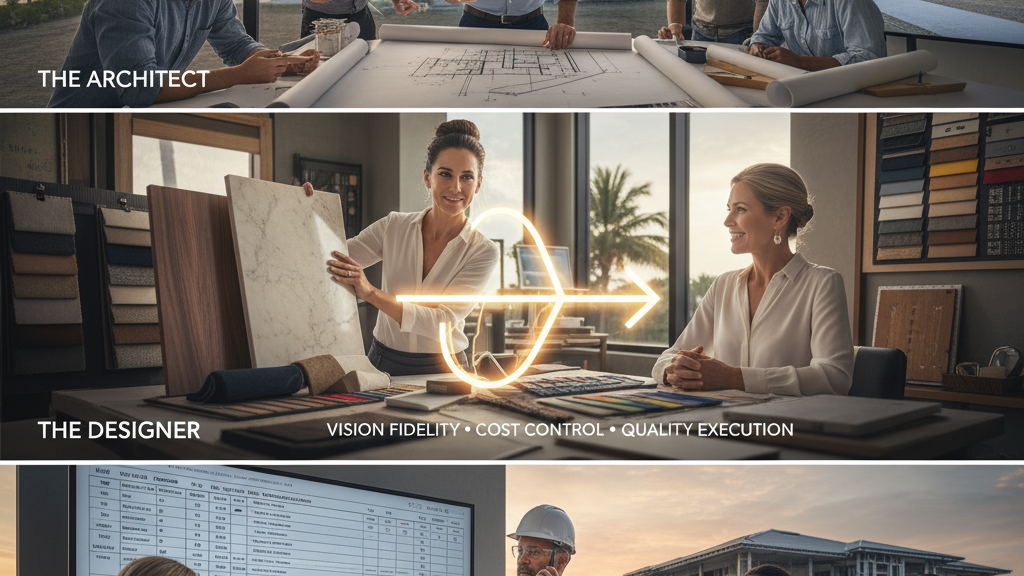
Every unforgettable custom home has one thing in common: a team that communicates early, often, and honestly. After 10 years managing high-end residential projects, I can say with confidence that Why Collaboration Between Builder, Architect, and Designer Is Key to Success comes down to four outcomes clients care about most—vision fidelity, budget control, schedule certainty, and a flawless finish. When all three parties work in lockstep, you get a home that looks beautiful, lives beautifully, and performs beautifully for years to come.
The Stakeholders & Their Roles
Role of the Architect
Vision, design language, structural integrity and code compliance
The architect translates your lifestyle into space, proportion, light, and flow—then threads that vision through local codes and structural logic. They frame the big idea, protect the design language, and coordinate the technical backbone (structure, egress, envelopes). In a well-run project, the architect champions the intent while staying open to constructability input from the builder and finish direction from the designer.
Role of the Builder/Contractor
Construction planning, cost management, sequencing and buildability
The builder turns drawings into durable reality. They assemble bids, validate costs, plan critical path schedules, and coordinate trades. More importantly, they flag buildability concerns early so the team can refine details before they become expensive change orders. In luxury work, the builder’s sequencing and quality control determine whether the finishes the designer specifies actually look and perform as intended.
Role of the Designer (Interior/Exterior)
Material selections, finishes, furnishings, user experience and aesthetics
The designer is the curator of experience—surfaces, fixtures, lighting layers, soft goods, and the tactile “feel” of each space. Their choices must marry the architect’s geometry with the builder’s construction realities. When designers are involved from day one, they help align target budgets with finish aspirations, which keeps the project on track and avoids late-stage substitutions.
Why All Three Must Be Aligned
Avoiding silos, reducing mis-communication and re-work.
Working in silos invites misunderstandings: a beautiful concept that’s hard to build, or a finish schedule that doesn’t coordinate with lead times. Alignment creates a closed feedback loop where potential issues are spotted early and solved once.
Efficient workflows, cost control, timely delivery.
Aligned teams compress timelines by eliminating rework. They also protect the budget by preventing scope drift and confirming details before materials are ordered—true builder-architect-designer teamwork luxury home build process.
The Benefits of Early & Integrated Collaboration
Improved Budget & Schedule Control
Architects + builders working early avoid designs that blow budget. — Luxury Custom Home Builder in Maryland
Bringing the builder into schematic design allows for quick pricing checks and constructability input. As many luxury builders (including those often cited as a “Luxury Custom Home Builder in Maryland”) note, early collaboration turns the estimate into a steering wheel—not a post-mortem report.
Designers contributing from early phase reduce delays in finish selections.
Finish decisions drive long lead items (windows, appliances, stone). Early designer involvement ensures orders are placed on time and sequencing is realistic, which smooths the builder and architect designer coordination for custom homes.
Enhanced Build Quality & Design Integrity
Consensus on materials, systems, detailing leads to fewer issues on site.
When the architect, designer, and builder agree on assemblies—waterproofing, acoustic layers, lighting control—fewer field adjustments are needed. The result is a crisp, coordinated execution that preserves the design intent.
Better Value Engineering & Innovation
Joint team can find smart solutions that maintain design while optimizing cost.
True value engineering protects beauty and performance. For instance, swapping to a more readily available stone with similar veining can shave weeks off delivery while staying on concept. This is how builder architect designer collaboration improves custom home quality without sacrificing the look.
Greater Client Satisfaction & Fewer Disputes
Clear roles, transparent communication and workflow reduce stress and surprises.
Clients feel confident when decisions are documented and trade-offs are explained in real time. Transparency is the antidote to disputes.
Key Collaboration Milestones in the Custom Home Process
Pre-Design & Visioning Phase
Architect and designer collaborate to define style, layout, scope
Kick off with a shared vision session. The architect explores massing and flow; the designer assembles mood boards for tones, textures, and lighting layers. Everyone leaves aligned on aesthetic direction and scope.
Builder input on lot constraints, code/regulatory issues, cost parameters
The builder reviews survey, geotech, and HOA/city requirements to flag site access, staging constraints, and structural implications. Early pricing anchors the schematic plan to a realistic budget—key for collaboration builder architect designer custom home success.
Design Development & Documentation Phase
Designers pick interior/exterior finishes while architect finalises drawings
As the architect refines elevations and details, the designer selects finishes and fixtures tied to real lead times. The team coordinates junctions—how stone meets door frames, how lighting grazes feature walls—so drawings match the finish story.
Builder reviews drawings for constructability, logistics, schedule
Page-turn meetings catch conflicts early (e.g., duct paths vs. soffit lines). The builder produces a schedule that sequences long-lead items and mockups before full installation.
Construction Phase
Weekly coordination meetings among architect, builder, designer
Standing meetings are non-negotiable. Agenda: safety, schedule, RFIs, submittals, mockups, and upcoming inspections. This cadence keeps decisions ahead of the trades.
Change orders handled via unified team approach, not in isolation
When changes arise, the team presents options with cost/schedule impact. Decisions are documented so expectations stay clear—model collaboration between builder architect designer design-build projects Florida.
Post-Construction & Handover
Designer oversees finish quality, architect ensures design intent, builder manages commissioning
The designer verifies finish alignment and staging; the architect confirms details match drawings; the builder tests systems (HVAC, lighting controls, water features) and compiles O&M manuals.
Client walkthrough, snag list, warranty briefing — coordinated by all
The team jointly leads the walkthrough, records punch items, and sets expectations for warranty response times. Clear closure is part of quality.
Common Collaboration Breakdown Points & How to Avoid Them
Late Involvement of One Party
Builder brought in too late → cost overruns, unbuildable design. — Luxury Custom Home Builder in Maryland
Late builder input forces expensive redesigns. Remedy: choose your builder early so preconstruction guidance shapes the drawings from day one.
Designer added after construction begins → finish delays, change orders.
When finishes are selected mid-build, lead times collide with rough-in milestones. Remedy: lock core finishes during design development to avoid costly pivots.
Poor Communication & Unclear Roles
Misalignment leads to finger-pointing and schedule slip. — simsbuilders.com
Builders like those at simsbuilders.com stress written responsibilities and decision pathways. Remedy: a responsibility matrix (who decides what, by when) and RFI turnaround standards.
Budget or Timeline Blindspots
Designer chooses luxury finishes without builder/budget input → budget blowout.
Remedy: tie every finish to a budget allowance and track against a running cost report. No surprises.
Architect ignores site constraints and builder logistics → delays.
Remedy: early logistics planning—crane pads, material hoists, staging—folded into the design.
Scope Creep & Change Orders
Without unified team, incremental changes cause cost/time escalation.
Remedy: a formal change management process with pricing, schedule impact, and approvals before work proceeds.
Lack of Shared Vision & Document Control
When architect, builder and designer don’t share the same vision, quality suffers.
Remedy: one source of truth—current drawings, finish schedules, and meeting minutes in a central platform everyone uses.
Strategies to Ensure Strong Collaboration from Day One
Select the Core Team Early
Choose architect, builder and designer as a coordinated team.
Shortlist partners with a history of working together. Chemistry matters—so does a shared standard for excellence.
Evaluate past collaborative projects & communication style.
Ask for references on teamwork, not just outcomes. You want a team that resolves friction quickly.
Establish Clear Roles, Agreements & Expectations
Define scope, responsibilities, workflow, decision-making process.
Use a responsibility matrix and decision ladder (who decides, who advises, who’s informed). Put it in the contract.
Use design-build or integrated delivery models when appropriate. — Wikipedia
Integrated models reduce fragmentation. As widely summarized on Wikipedia, design-build can streamline delivery when roles and incentives are aligned.
Promote Open & Regular Communication
Weekly or bi-weekly coordination meetings, shared dashboards or project management tools.
Adopt shared tools for RFIs, submittals, schedules, and budgets—everyone sees the same data in real time.
Transparent budget-updates and schedule status.
Publish a monthly executive summary for the client: progress photos, risk watchlist, contingency balance, and upcoming decisions.
Encourage Joint Problem-Solving
When design or site issues emerge, team meets to find best solution, not blame. — simsbuilders.com
A no-blame culture speeds solutions. Pull in the right trade partners early to co-create fixes that protect design and cost.
Maintain Flexibility & Contingency
Build in contingency for changes, maintain adaptability in design and budget.
Carry 10–15% contingency. Use alternates for finishes so the look is protected if a material slips or spikes in price.
Designer, architect and builder should review value engineering together.
VE shouldn’t downgrade the experience. Review as a trio and approve only substitutions that keep the design language intact.
What Collaboration Looks Like in Luxury/High-End Custom Homes
High Finishes & Bespoke Elements
Designer selects bespoke finishes, architect coordinates detailing, builder executes flawlessly.
Think book-matched slabs, custom metalwork, artisan millwork. Precision shop drawings and on-site mockups ensure the final look matches the vision—true builder-architect-designer team luxury home build success factors.
The team must ensure finishes are compatible with structural and build systems.
For example, large-format stone requires substrate prep and deflection limits. Collaboration aligns structure, adhesives, and grout systems before installation.
Complex Sites & Unique Floor Plans
On challenging lots (coastal, waterfront, elevated) the builder/architect/designer must be integrated from day one.
Flood elevations, wind loads, and HOA rules affect massing and finishes. Early coordination avoids redesigns and keeps permits on track.
Technology, Smart Homes & Integrated Systems
Designers introduce smart home features, architect ensures infrastructure, builder installs accordingly — collaboration vital.
Lighting control, shades, AV, and security must be wired and ventilated correctly. Sequence matters—rough-in decisions happen months before finishes.
Brand or Signature Homes & Unique Market Expectations
Collaborative team needed to deliver brand-quality/architectural-signature homes that the luxury market expects.
Signature results demand signature teamwork—tight documentation, quick decisions, and unwavering quality standards.
Checklist for Homeowners: How to Foster Collaborational Success
Ask these questions when assembling your team
“Have you worked together previously?”
Established teams communicate efficiently and anticipate each other’s needs—your schedule and budget benefit.
“How will you coordinate on budget/schedule/finishes?”
Look for a clear process: pricing checkpoints, finish deadlines, and mockup approvals.
Check documentation and communication plan
Does your contract define design-build standards or role of each professional?
Contracts should include a responsibility matrix and decision timelines so progress never stalls.
Is there a shared communication workflow (tools, meetings, updates)?
Ask to see a sample dashboard or status report. Transparency is non-negotiable.
Monitor collaboration during build
Attend coordination meetings, review budget/schedule reports, witness team decision making.
Be present for key milestones and mockups. Your feedback is crucial, and early input is always cheaper than late changes.
Post-Build reflection
Review how challenges were handled, how decisions were made — this will affect warranty and value.
Debrief with the team after move-in. Capture lessons and maintain a clean record set—drawings, manuals, warranties—for future value and maintenance.
FAQs Around Builder, Architect & Designer Collaboration
Do I need all three (architect, builder, designer) for a custom home?
For high-end results, yes. Each discipline protects a different aspect of success—vision, performance, and finish quality. Together, they reduce risk and elevate outcomes.
At what stage should I involve each professional?
Bring all three in before schematic design. Early alignment is the fastest way to a realistic budget and a reliable schedule.
What if my architect and builder don’t work well together?
Choose professionals with proven collaboration. If friction appears, define a decision ladder and mediation path to keep the project moving.
Can a design-only or build-only contract work if collaboration is weak?
It can, but risk rises. If you don’t use integrated delivery, require structured coordination meetings and shared documentation standards.
How much extra time or cost does a collaborative process involve?
Done right, it saves time and money by preventing rework, missed lead times, and design conflicts. Think of it as an upfront investment that reduces downstream surprises.
Conclusion – Collaboration as the Foundation of a Successful Build
Recap of key reasons why collaboration is critical for achieving vision, budget, quality and schedule.
Why Collaboration Between Builder, Architect, and Designer Is Key to Success is simple: unified decisions, fewer changes, faster approvals, and finishes that look and perform as intended. It’s the difference between “built” and “beautifully built.”
How an aligned builder/architect/designer team creates a smoother experience and better outcome.
When roles are clear and communication is consistent, you get predictable timelines, controlled costs, and a result that feels personal and purposeful—true builder-architect-designer teamwork luxury home build process in action.
Final advice for homeowners: choose your team wisely, foster communication, invest in the process.
As you plan your project, choose a team with a track record of collaboration. Start early, meet regularly, and document decisions. Explore where we work via Our Service Area, find style inspiration in Explore Custom Home Types in Stuart, FL, and review nearby market insights in Affordable Luxury: Best Home Builders in Palm City, Florida. Ready to assemble the right team for your custom home? Call 561-962-4567 and let’s build your vision—together.